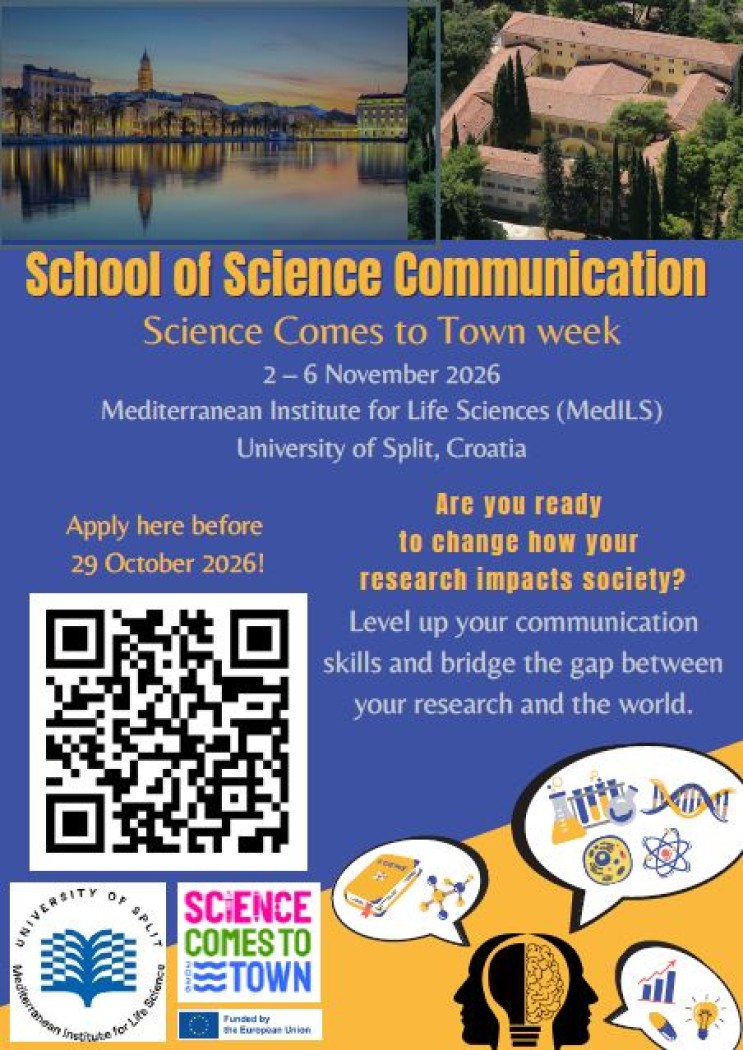
Are you ready to change how your research impacts society?
We invite you to the upcoming 5-day international workshop entitled “School of Science Communication”, which will be held from November 2nd to November 6th, 2026 at the beautiful Mediterranean Institute for Life Sciences (MedILS), University of Split, in Split, Croatia.
This intensive program is organized as a special “Science Comes to Town Week at MedILS UNIST” event under the umbrella of the EU-funded project Science Comes to Town 2026. Being part of this prestigious European initiative means you are joining a vibrant, pan-European movement bridging science and society (https://sciencecomestotown.eu/). This exclusive program is specifically designed for a group of 20 master students, PhD students, and junior postdocs who want to take their careers to the next level through impactful engagement, direct international networking, and fully supported participation.
Scientific literacy includes much more than just reading, debating, and interpreting data; it dictates how your research profoundly impacts society. Most conventional training teaches researchers how to broadcast facts to passive listeners, but this intensive program challenges that dynamic. In an era of rapidly developing AI, where algorithms and social media heavily influence human behaviour and values, critical thinking is increasingly fractured. Science communication must move beyond standard presentation toward active, meaningful engagement. By exploring the specific whys and whos of your research, this training will teach you to use science communication as a powerful tool to empower society and bridge societal divides. The school will guide you in engaging a diverse range of actors – from specific targeted groups like media professionals and policymakers to specialized professional environments – while also confronting difficult internal topics regarding scientific integrity and questionable research practices.
Beyond the lecture hall: how will you learn?
This school departs radically from traditional, passive academic seminars:
● 15/85 rule: Frontal teaching is limited to less than 15 % of total program time. You will learn, experience and reflect through complete physical and cognitive involvement
● Hidden agenda: Using specially designed activities, consequence-building games and exercises, you will learn to navigate task conflicts, evaluate your and audience needs, and defend positions without resorting to rigid scripts.
● Continuous reflection: Every activity fit within well-structured and interconnected scheme. Structured debriefs help you map workshop experiences directly back to your group dynamics, personal needs and interactions with the outside-of-your-group interactions.
Rather than handing you a generic template, this training acts as an incubator for your personal voice as a scientist. By enabling you to constantly re-evaluate your goals, target audiences, and ethical boundaries, you will end with a custom-built communication strategy designed for real-world impact.
Training will be delivered within three axes:
Why communicate about science?
By analysing personal involvement and goals we help participants to reflect upon deficit model and consider more active dialogue between science and society. Participants are encouraged to develop and practice different modes of interaction with a diversity of public. Especially, participants are invited to consider how science communication can be used as a tool for empowering people with critical skills.
Making choices
Participants will address different goals of science communication and decide upon their own history, social background and experience on which side of science and research they wish to communicate. They will analyse complex relationship among different stakeholders and their interest in science topics or research practice. By focusing on needs of specific targeted public varying from professionals in their fields like members of media, policy makers, teachers to general audience like youth, teenagers, parents or senior citizens participants will raise awareness of different levels science communication fits within scientific literacy. They will be introduced to concrete example where science communication is powerful tool for conflict resolution and peace building process.
Reshaping activities
Most often, participants enrol in science communication training with preliminary ideas of activities or presentational goals. This training will enable them to redefine and reshape approaches according to their new choices.
Important details:
• Application deadline: 28 October 2026
• Application link: https://forms.cloud.microsoft/e/rMWMTnJdAQ
• Location: Mediterranean Institute for Life Sciences (MedILS), University of Split, Meštrovićevo šetalište 45, 21000 Split, Croatia
• Date: 2 – 6 November 2026
• Target participants: 20 master students, PhD students, and junior postdocs (evaluated on the application letter and on a first-come, first-served basis)
• Accommodation: Offered at the school venue
• Travel: Please note that travel arrangements needs to be covered by participants.